EAT • SLEEP • REVIEW • REPEAT
MORTAL KOMBAT II
Director: Simon McQuoid
Writer: Jeremy Slater
Cast: Karl Urban, Adeline Rudolph, Jessica McNamee, Ludi Lin, Josh Lawson, Tati Gabrielle, Lewis Tan, Hiroyuki Sanada
Not a flawless victory, but a bloody fun one.
After spending such a long time as the butt of everyone’s jokes, video game adaptations may have finally shaken their hoodoo. Whether it’s Fallout, Arcane or The Last of Us, the much maligned genre looks to have got its act together at last. Granted, these days the best adaptations tend to be found on television, however, even the likes of Sonic the Hedgehog and Gran Turismo feel like Citizen Kane compared to the big screen 8-bit slop served up in decades gone by.
Yet, despite this recent resurgence, there’s one video game sub-genre that still struggles to land its punches. While other genres have found a way to make the video game thing work on screen, fighting games continue to flounder. Whether it’s the dearth of adaptable narratives within a gaming style that trades heavily on brawling rather than intricate storytelling, or simply a lack of understanding as to what makes the genre tick, whatever it is, there have been so few objectively good fighting game adaptations through the years.
With this in mind, 2026 feels like a massive year for big screen fighting games, with two of the genres biggest hitters looking to land a KO and alter the negative perception these adaptations have forever. So, while the success of Street Fighter is a question for another day, this is the perfect opportunity for Mortal Kombat II to get its punches in.
The champions of Earthrealm, now joined by washed-up Hollywood action star Johnny Cage (Karl Urban), are thrust into an interdimensional tournament to stop the tyrannical Shao Kahn (Martyn Ford). As Earthrealm faces its tenth consecutive potential loss, which would grant Outworld total control, the fighters must navigate a landscape of lethal duels and shifting loyalties to prevent their world's annihilation.
While 2021’s Mortal Kombat was a moderate success with fans and at the box office, it’s fair to say it wasn’t exactly a knockout. With buckets of blood and an appropriately schlocky approach, it got the general look, energy, and feel of what makes Mortal Kombat so fun as a game, yet the film just couldn’t find a way to mould a story around it, while the fight sequences, fun though they were, often felt drowned out by muddy, messy CGI.
Mortal Kombat wouldn’t be the first video game movie series to suffer from such issues, however, five years on from the first entry in this latest era of the long running franchise, you’d have hoped that at least some of the criticism would’ve been taken on board for the sequel. However, while there are clearly some improvements with Mortal Kombat II, the overriding feeling of history repeating itself is hard to shake off.
With lashings of fan service, a tonne of familiar characters, buckets of blood, bone crunching fights, and plenty of brutal fatalities, Mortal Kombat II knows precisely what it is and what people want from it, and, in that respect, it undoubtedly delivers. Which is all well and good. Yet, what the film doesn’t do, is offer much outside of this.
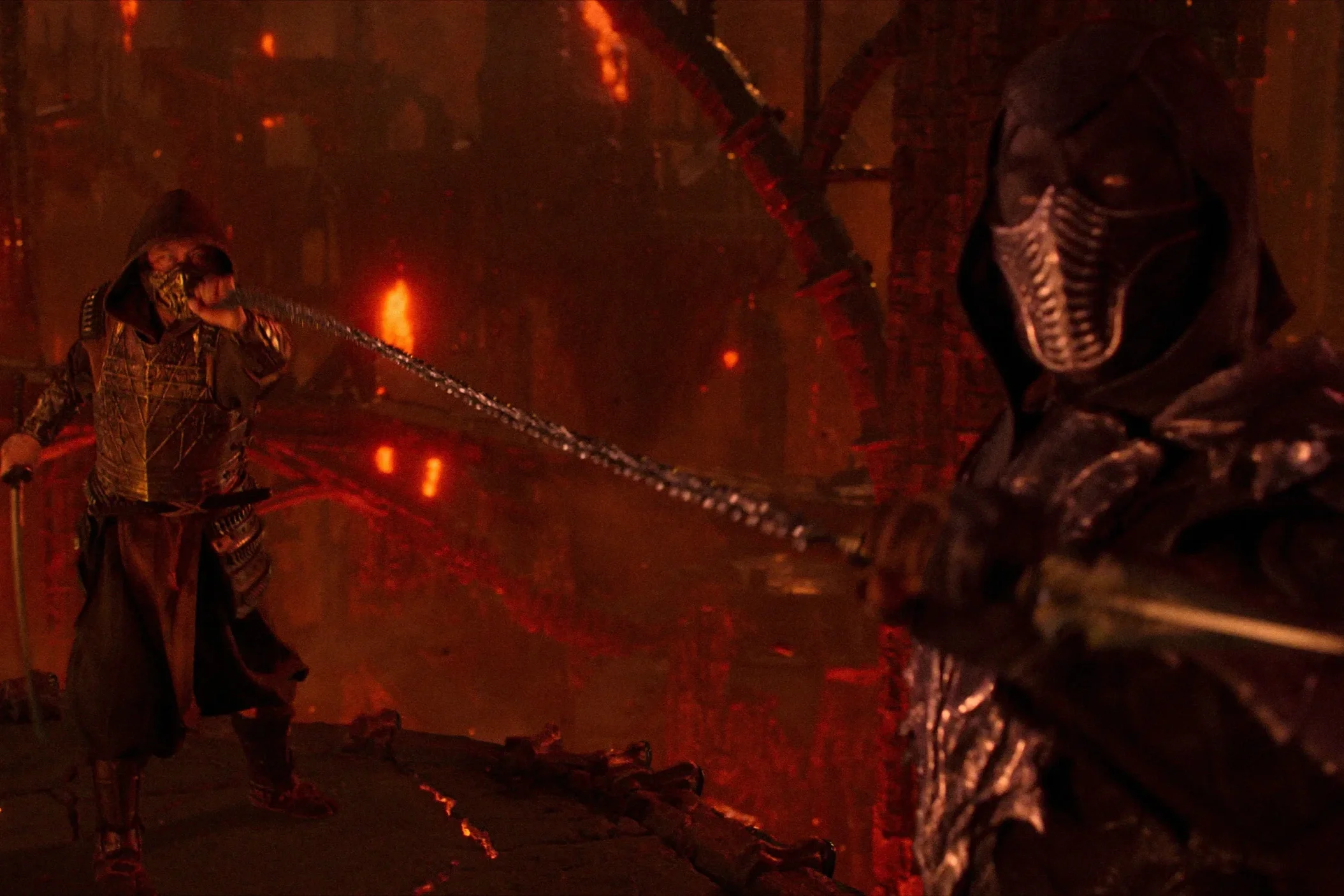
As with its predecessor, Mortal Kombat II delivers precisely the kind of campy, trashy, OTT fight sequences you’d hope for from a franchise that made its name from its giddily heightened level of extreme (and frequently silly) violence. This feels like a bare minimum requirement for any Mortal Kombat movie, and the latest instalment doesn’t disappoint with fights that use moves, locations, pitch black humour, and the general gnarly energy of the game in a way that honours the source material while making it work as a big screen spectacle.
These fights are fun, ridiculous, and bloody in all the ways you want them to be for a Mortal Kombat movie, however, while the visuals are undoubtedly a step up from the first film, there’s still very much a sense of messiness with its CGI. Although it may feel a tad harsh to criticise a video game movie for looking too much like – well – a video game, but there are definitely limits to these things and Mortal Kombat II comes mightily close to breaching them by making absolutely everything look and feel distinctly artificial.
Whether it’s the various fight backdrops or some of the wilder action sequences, the film frequently feels like an avalanche of murky, floaty CGI that, even by video game standards, feels disappointingly intangible. Fun and enjoyable, yes, yet its insubstantial nature just feels so hollow at times.
It’s the kind of inconsistent visual effects that you could let slide had the film been able to back itself up elsewhere, yet Mortal Kombat II struggles to significantly improve on the first movie across the board. With ropy dialogue, an erratic plot, and questionable acting, it’s clear that many of the faults that hit the first film continue to dog its follow-up.
Of course, no one expects a writing or acting masterclass from a film like this, however, there must be something in there to keep us hooked. So, while Mortal Kombat II’s plot certainly feels like a decent step up from its predecessor and the always excellent Karl Urban does his utmost to inject plenty of cheesy charm into proceedings as Johnny Cage, there really are too many issues elsewhere to ignore.
In particular, the plot finds itself so bogged down in unrelenting fan service to fully follow through on its initial promise. The emotional hook of Kitana’s drive for vengeance and Johnny Cage’s search for redemption mean the film has a solid core to it, while the tournament setup is about as classic Mortal Kombat as it gets, yet around it there are so many additional characters and plot strands thrown in that it becomes far too messy and inconsistent to truly satisfy.
Bringing an infectious energy and a clear love for the franchise, Simon McQuoid does well to mould Mortal Kombat II into something infinitely watchable and incredibly enjoyable, however, the director can’t quite craft a consistent narrative out of Jeremy Slater’s script. Switching plot threads and throwing new characters into the mix at a rate of knots, the film winds up a bit of an incoherent mess, albeit a perfectly watchable one.
It’s a desperate, over enthusiastic attempt at fan service that’s plagued many modern franchise films, not to mention video game ones, and Mortal Kombat II slips up on this front once again as it frequently feels more concerned with throwing an abundance of Easter eggs, iconic moves, and popular characters at us than telling a consistent story.
The result is a chaotic, erratic, hot mess of a movie, yet an incredibly fun one that does precisely what it needs to do to get you on board, if not entirely falling in love with it. Yes, Mortal Kombat II undeniably kicks ass in a way that fans will love, but like almost every other fighting game film out there, it lacks the narrative drive and depth that’s become a key part of the recent video game adaptation boom.
Lashings of fan service, a tonne of iconic characters, gloriously gory fights, brutal fatalities – it’s hard to argue that Mortal Kombat II doesn’t know exactly what it wants to be, and in many ways, it delivers on what it promises. Embracing the gloriously gory excess and 90s schlock that the games were born from, Mortal Kombat II is bloody fun and a step up from the first film but with shaky CGI, ropy dialogue, and an erratic plot, it struggles to offer a whole lot more than frenzied fan pandering.